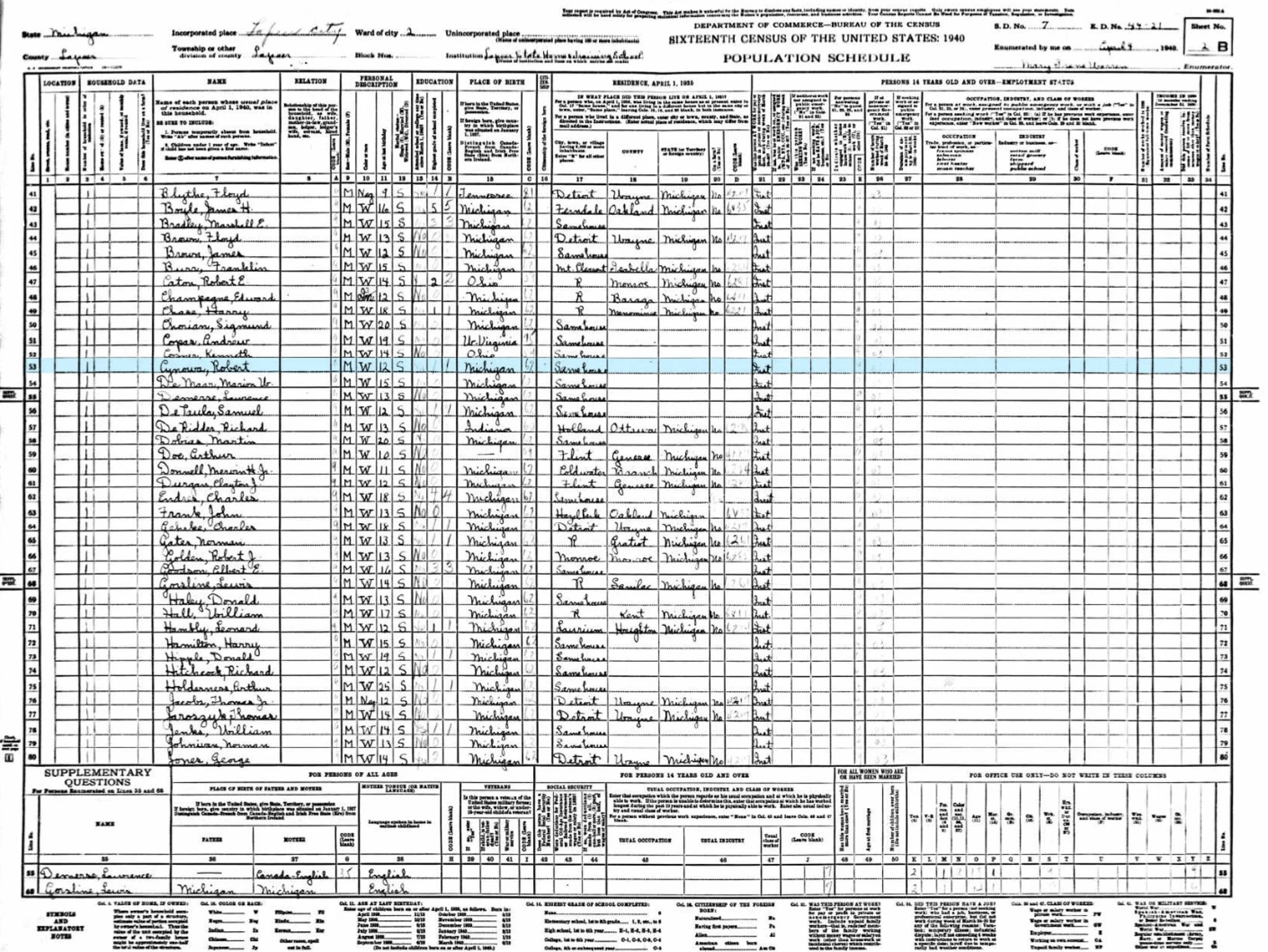
Robert Cynowa 1940 Census
Robert (12)
To begin with, this census does not depict the typical family structure, including the head of household and all members who shared it.
This census sheet represents various housing blocks within the Lapeer State Home, which had a population exceeding 4,600.
Notably, Robert is listed with the surname Cynowa, despite his birth certificate indicating the surname Travis. It remains uncertain whether he assumed Cynowa as his surname, as he was relocated to the institution at a very young age.
At the conclusion of this introductory section on Robert’s 1940 census, several links are provided to the atrocities that transpired at the Lapeer State Home.
Briefly, the state of Michigan utilized the Lapeer State Home as a repository for children displaced from their families during the Great Depression. These children were placed in a facility alongside individuals with mental disabilities.
The state lacked a plan to educate these children or provide a pathway for their reintegration into stable family structures. Consequently, they became prisoners of the institution. To exacerbate the situation, the Lapeer State Home collaborated with local farmers to provide them with able-bodied young boys for agricultural labor. This arrangement offered farmers inexpensive labor and reduced the institution’s overhead costs while the boys were dispatched.
In Robert’s case, he recounted residing in the barn of a farmer during this period of child and labor abuse.
Robert was eventually released from the Home, contingent upon his mother, Anna, signing an approval for the state to sterilize him. In 1923, Michigan legalized sterilization for individuals deemed “feeble-minded.” This practice persisted until 1950s and 1960s.
The Travis side of this narrative may have concluded there had it not been for the subsequent events. Frank Cynowa, Anna’s eldest son, visited his mother. She presented Frank with the letter of authorization she received from the Lapeer State Home.
Frank informed his mother to refrain from signing the document. He promptly commenced efforts to devise a strategy for challenging the situation and securing Robert’s release without undergoing sterilization.
Frank dedicated several hours to the Detroit Public Library, diligently researching and compiling evidence to construct a compelling case that would enable Robert’s liberation from the institution’s unethical practices.
We express our sincere gratitude to Uncle Frank for all of us living today because of your efforts.